

Fiber Cement Boards in Modern Building Systems: A Technical Perspective Based on FEEPOP
Among the wide range of building materials used today, fiber cement boards have gradually evolved from a supplementary substrate material to a key component in architectural systems. Represented by the FEEPOP Fiber Cement Board series, the performance upgrades in formulation, density, and engineering adaptability make this material not a mere replacement but a capable and proactive participant in modern construction.
Matching Material Performance with Building Requirements
1. Fire-Safety as a Defining Boundary
FEEPOP fiber cement boards are classified as A1 fire-rated, non-combustible materials. Unlike conventional boards that meet only minimum code requirements, A1 performance provides a higher margin of safety—remaining stable under direct flame and without releasing toxic smoke. This characteristic is especially relevant in public spaces, residential buildings, and healthcare facilities, where fire resistance is more than an individual specification—it is a core design principle.
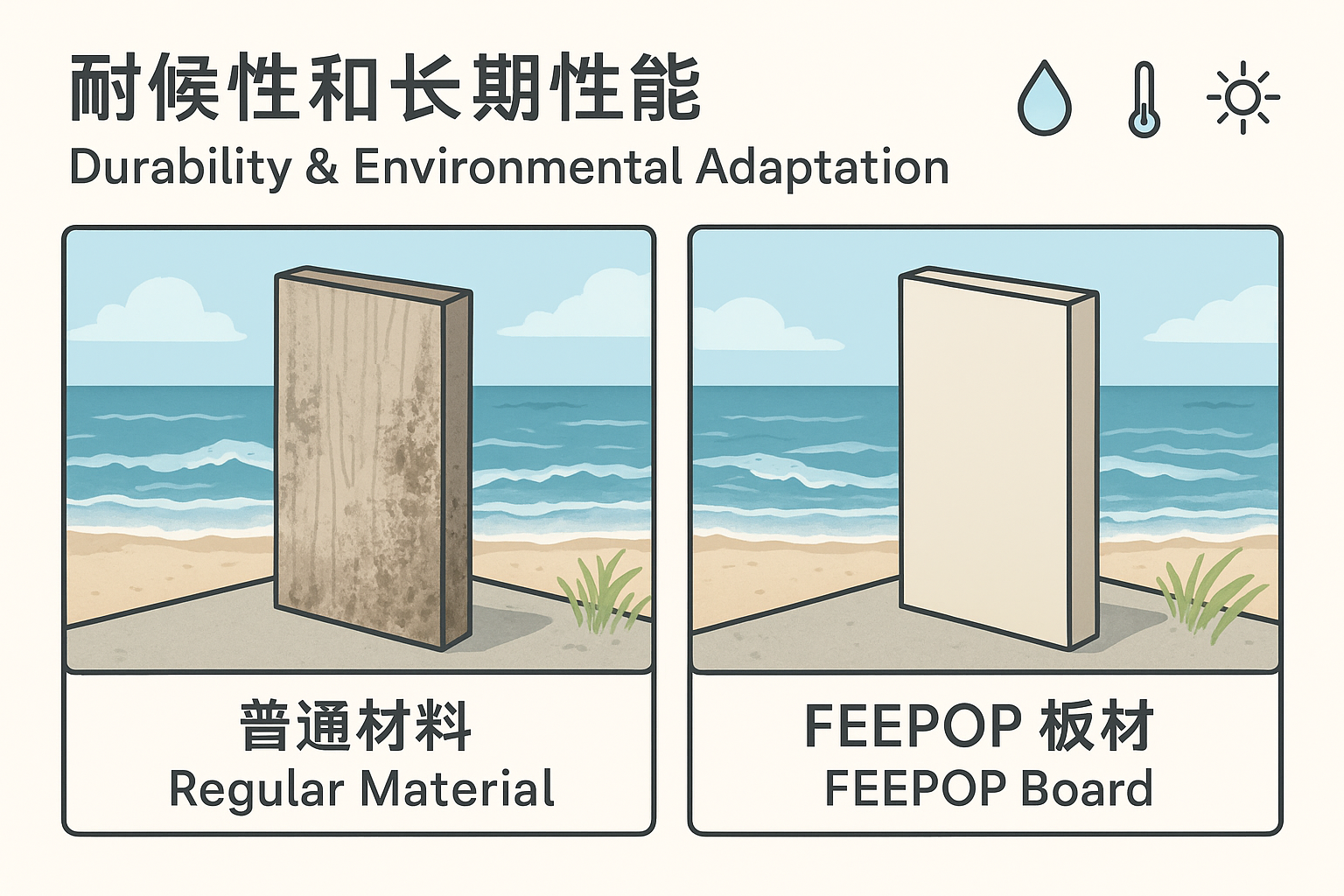
2. Stability and Environmental Adaptation
Building materials are exposed not only to static loads but also to humidity cycles, temperature fluctuations, and long-term environmental decay. In high-humidity, coastal, or semi-exposed environments, FEEPOP boards behave closer to a long-term structural material rather than a responsive or temporary layer. The result is durability across the building's lifecycle, which is increasingly valued in contemporary architecture.
3. Acoustic and Thermal Properties
Density remains one of the most critical parameters for acoustic design. The high-density formula of FEEPOP delivers effective sound insulation for wall partitions, facade systems, and interior spaces with increased acoustic requirements. Combined with a low thermal conductivity, the material contributes positively to thermal stability and building energy efficiency, a topic strongly emphasized in modern building codes.
4. The Balance Between Strength and Lightweight Design
Pressed under large-tonnage equipment, FEEPOP fiber cement boards offer high bending strength and impact resistance while maintaining a lightweight profile. For designers and contractors, this dual advantage translates to reduced structural load, easier transport, and improved construction efficiency.
Construction Logic and System Integration
The value of fiber cement boards is not defined solely by the material itself but also by their compatibility with construction systems. FEEPOP supports fully dry installation and is compatible with lightweight steel or wooden framing systems. Cutting, drilling, and slotting can be performed directly on-site, which aligns well with current preferences for faster installation and minimized wet processes.
Beyond a Single Application Category
When the performance spectrum widens, so do the applications:
Thin boards for ceilings, perforated acoustic panels, and interior finishes
Standard-thickness boards for internal walls and exterior cladding
Thick boards for load-bearing scenarios, loft flooring, facade insulation systems, and even landscape structures
In landscape and outdoor applications, FEEPOP's Plank Board demonstrates a longer service life than wood and WPC materials, due to its resistance to corrosion, moisture, and surface degradation.
A Shift in the Material Logic of Architecture
Traditional material selection often revolved around structural feasibility and cost. Today, the conversation includes durability, fire safety, comfort, environmental impact, and lifecycle cost. The evolution of fiber cement boards is closely aligned with these industry shifts.
FEEPOP represents this transition. The material exceeds its conventional role as an internal substrate and becomes a versatile building component that contributes to multiple dimensions of architectural performance: structure, durability, safety, and design flexibility.
As modern buildings embrace modular construction, lightweight systems, and sustainability-driven design, high-performance fiber cement boards are no longer supplemental resources—they are becoming a foundational language of contemporary building materials.
