

2026 Fiber Cement Board Market Update: Why Builders Are Turning to Fiber Cement Solutions
Fiber Cement Board Market 2026 | Construction Trends & FEEPOP Solutions
Explore the latest fiber cement board market trends in 2026, including fire safety regulations, green building demand, and how FEEPOP fiber cement boards support modern construction projects.
2026 Fiber Cement Board Market Update: Why Builders Are Turning to Fiber Cement Solutions
The global construction industry continues to evolve in 2026. Developers and contractors are facing stricter fire safety regulations, stronger sustainability requirements, and increasing pressure to complete projects faster.
As a result, the choice of building materials is changing. Materials that offer durability, fire resistance, and easy installation are becoming the preferred option across many types of projects.
This is one reason fiber cement boards are seeing wider adoption worldwide. They provide a practical balance between safety, performance, and cost efficiency.
Manufacturers such as FEEPOP Board are focusing on producing fiber cement boards that meet these modern construction requirements.
Fire Safety Regulations Are Driving Demand for Non-Combustible Materials
One of the biggest factors influencing the building materials market today is fire safety regulation.
Many countries have strengthened fire codes for:
High-rise buildings
Commercial complexes
Public infrastructure
Industrial facilities
These regulations often require non-combustible construction materials in wall systems, ceilings, and exterior facades.
Fiber cement boards naturally meet these requirements. They are widely used in fire-rated wall systems because they offer reliable fire performance without requiring complex installation.
FEEPOP fiber cement boards are A1 non-combustible and asbestos-free, making them suitable for projects where fire safety compliance is critical.
In many cases, they replace materials such as plywood, plastic panels, or other boards that do not meet updated fire standards.
Green Building Standards Are Influencing Material Choices
Sustainability has become another key factor in construction projects.
Many commercial developments now follow green building frameworks such as LEED or other regional sustainability standards. These frameworks encourage the use of materials that are durable, environmentally responsible, and low maintenance.
Fiber cement boards support these goals because they offer:
Long service life
Stable performance in different climates
Minimal maintenance requirements
Safe, asbestos-free composition
For developers and property owners, this helps reduce lifecycle costs while maintaining building safety and structural reliability.
Fiber Cement Boards Fit Well with Modern Construction Methods
Construction methods are also changing. More projects are adopting prefabrication and dry construction systems, which require materials that are stable, easy to handle, and quick to install.
Fiber cement boards are well suited for this type of construction.
They are commonly used in:
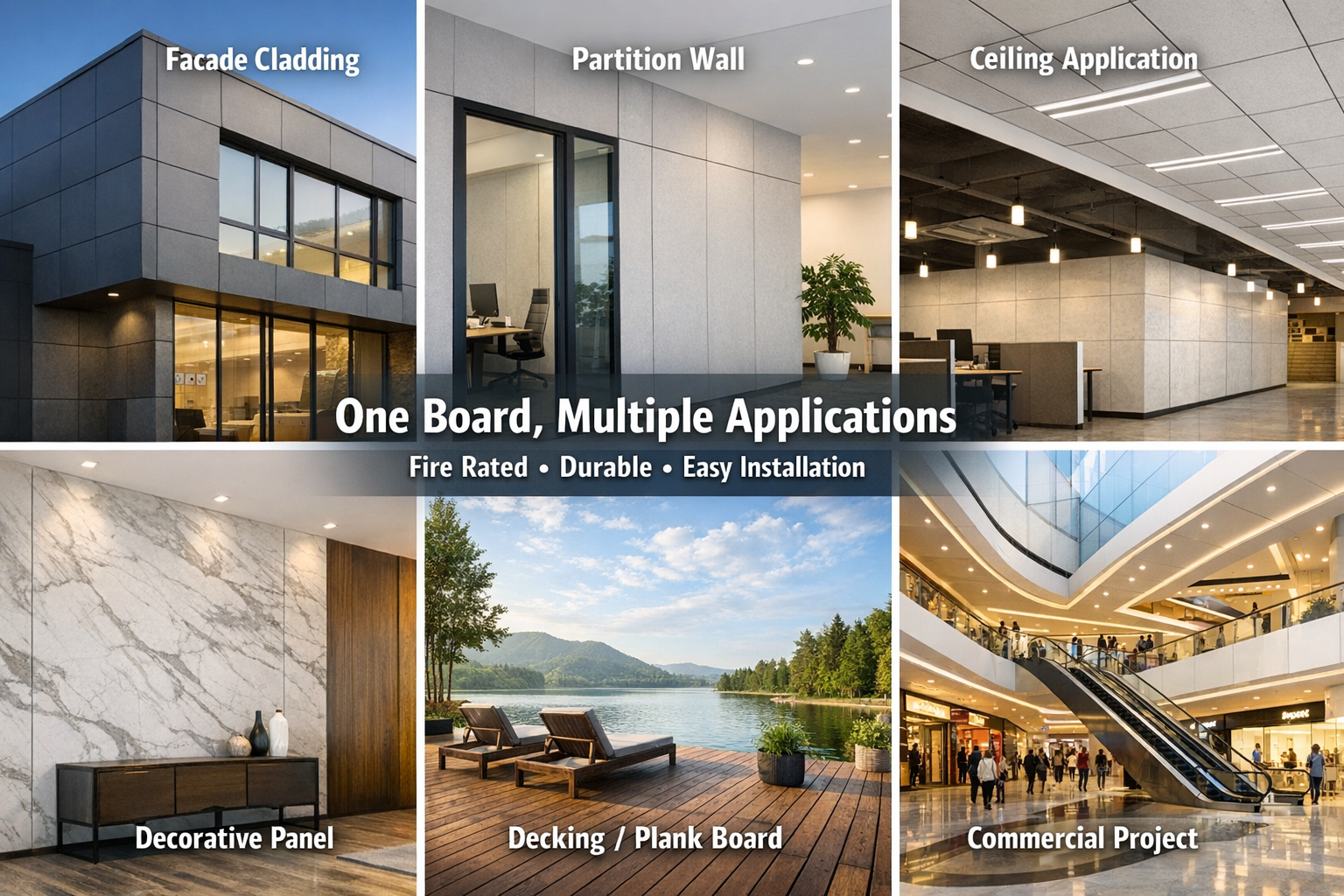
Interior partition walls
Ceiling systems
Subfloor base boards
Exterior cladding panels
Because they are dimensionally stable and easy to cut on site, they help contractors improve installation efficiency and reduce construction time.
This flexibility is one reason fiber cement boards are used in both residential and commercial buildings.
Southeast Asia Is Becoming a Key Growth Market
While fiber cement boards are used worldwide, Southeast Asia has become one of the fastest-growing markets for this material.
Countries such as Indonesia, Vietnam, and the Philippines continue to experience rapid urban development. Housing demand, infrastructure investment, and commercial construction projects are all expanding.
These markets require materials that can perform well in humid and tropical climates while still remaining cost-effective.
Fiber cement boards are well suited to these conditions. Their moisture resistance and structural stability make them reliable for wall systems, exterior facades, and other applications.
FEEPOP has been supplying products to these markets for applications ranging from partition walls to facade systems and outdoor plank boards.
Decorative Fiber Cement Panels Are a Growing Segment
Another noticeable shift in the industry is the growing demand for decorative building materials.
In the past, fiber cement boards were mainly used as structural base boards. Today, architects and developers are also using them as visible surfaces in interior and exterior design.
To support this trend, FEEPOP provides a wider product range, including:
Standard fiber cement boards for wall and ceiling systems
Marble-look decorative panels for interior applications
Wood-grain boards for exterior facade systems
Plank boards for outdoor decking and walkways
Flexible soft stone panels for lightweight decorative finishes
This allows architects to maintain consistent materials across different parts of a building while improving visual design.
What Buyers Expect from Fiber Cement Board Suppliers
Compared with previous years, buyers are now more focused on overall performance and reliability rather than simply the lowest price.
Project teams usually look for materials that provide:
Certified fire resistance
Stable board quality and flat surfaces
Compatibility with common installation systems
Long-term durability with low maintenance
Manufacturers that can consistently deliver these qualities are more likely to build long-term partnerships with contractors and developers.
Outlook for the Fiber Cement Board Market
Looking ahead, the outlook for the fiber cement board industry remains positive.
Several long-term trends are expected to continue:
Stronger enforcement of fire safety standards
Increasing use of prefabricated construction methods
Higher demand for durable and low-maintenance materials
Continued growth of decorative fiber cement products
As these trends develop, fiber cement boards will likely remain an important material in modern construction systems.
Companies like FEEPOP Board will continue focusing on reliable products that help builders meet safety requirements, simplify installation, and deliver long-lasting performance.
